
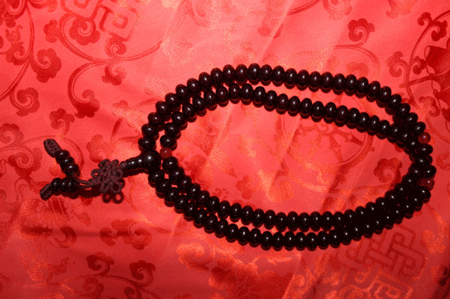
The descriptions of rosary are divided into the following eight sections:
- The origin of rosary
- The enumeration
- The rosary string
- The mode to string the rosary
- The counter beads of rosary
- The blessing
- The counting method
- The samaya
- The origin of rosary
The origin of rosary can be divided into four categories:
I. Identity
II. Etymology
III. Category
IV. Purpose
I. The identity of rosary
The lamp of tantra illuminating the principles of rosary states thus; Firstly, the identity of a rosary – It is threaded close and is finite in number. It is used as adornments and is arranged in successive order to hold the approximation of mantra recitation.
II. The etymology
The same text states:
Beings possessing faith and belief
Are bonded to their master and so forth.
The etymology of rosary is thus stated accordingly, like the three root and vajra brothers and sisters are bonded to each other. Since, it is called threng-wa in Tibetan, which literally means to be bonded or to be fond of each other.
III. The category
According to the same text, the categories of rosary are the rosaries to be adopted and rosaries to be discarded. The categories of rosary to be adopted are as follows: Rosaries made of Jewel are supreme, made of fruits are intermediate and made of wood, earth; stone and the rosary of medicine dough are of inferior quality. The rosaries made of conch shell and bodhi wood are auspicious for peaceful activity. Gold, apricot and fruits like mulberry accomplish enriching activity. Coral, tamarisk and medicine rosaries are for magnetizing activity. Iron, turquoise, black teak and bone accomplish wrathful activity. Divine agate, bodhichi, ivory and rosary made of different kinds are preferable for all activities.
As for the colour, white is praiseworthy for peaceful, yellow for enriching, red for magnetizing and black for wrathful activity. Multicoloured rosary is used for accomplishing every activity.
The rosaries to be discarded are – those classes of rosaries which are not revealed in the genuine tantra texts. Since such rosaries are not effective in accomplishing divine power, they must be discarded. In case of rosaries of glass and oysters etc, they are explained and revealed in later translation tantra. In short, those rosaries not explained in both, the earlier and later translation tantra must be avoided.
IV. The purpose
The same text says:
Generally, holding a rosary is considered a vow of tantra because it is the hand-sign of meditation deity. It is the symbol of upholding the enduring memory and figuring out the essence in enumeration. It is also an auspicious coincidence of wisdom mother and object of wealth. It ripens causal condition and power, raises the primordial wisdom of samaya and reveals the distinction between self and deity. Increases the limitless fruitions and revives the perspective of recitation mantras. It is an object for accomplishing entire activities of peaceful, enriching, magnetizing, wrathful etc. It is also a means for turning the three spheres of a teacher’s activity (exegesis, attainment and work). In this way, the general purposes of rosary are inestimable and specifically, it serves the purpose of holding the numerical limit of mantras.
The superior purposes of rosary are: it ascertains maturation and liberation of generation and perfection phase. As it is a skilful means from the gateway of secret tantra path, put the interdependence unity of all phenomena into practice. In this way it is stated that there are many such distinctive purposes of rosary.
- Enumeration
The same text states:
Though one hundred and eight is the commonly recommended number, it can also be half of hundred eight that is fifty four or twenty one or eleven. If you are reciting any mantra for peaceful activities, repeat eleven enumerations time and again. And proceed with chanting hundred, thousand, hundred thousand and so on according to the limits of enumerations mentioned in the valid scriptures. Similarly, repeat one hundred and eight enumerations for enriching, fifty four for magnetizing and twenty one for wrathful activities. Accordingly, recite all these mantras matching with numbers mentioned in the texts of one’s own spiritual tradition.
- The rosary string
From the same text: The strings of rosary are as follows:
Roll white woollen string for peaceful, yellow cotton for enriching and red silk for magnetizing. Similarly, roll with the kinds of intestine, skin and leather cord for wrathful activities. For the rosary of different activities, roll with five coloured strings. Keep the thickness of the strings according to the size of the rosary. While stringing the rosary it should not be too loose or tight and the string should not be too long or short. Activities won’t accomplish if it’s extremely tight. Obstacles will occur, if it’s extremely loose. Deity accomplishment will delay, if the strings are extremely long. Life will be painful, if it’s too short. Misfortune will occur, if it is knotty, possess addendum and if there is inequality in the thickness of the strings. Likewise, we must understand such distinction and alike.
- The mode to string the rosary
The tantra text called Sambuti states:
While stringing the rosary visualize the thread as the principal deity and the beads of rosary as the assembly of retinue deities surrounding it and chant the HUNG syllable simultaneously.
- Counter bead
The same text states;
Roll the white thread in round shape for peaceful and yellow thread with knotty enclosure for enriching. Roll red flower, flat and crescent in shape for magnetizing. Roll black and triangular in shape for wrathful. Embellish with white, red and blue beads as the sign of body, speech and mind for various activities. Thus it is said that we must make the counter beads which accords with the respective activities.
In general the counter beads are made with three beads piled one upon another as the symbol of three vajras (indestructible body, speech and mind of Buddha). The colours are blue, red and white symbolizing mind, speech and the body of Buddha respectively from top.
- Blessing
The same text states:
Before using a new rosary for counting the mantra recitation we must conduct cleansing, purifying and consecrating rituals. The root tantra of Manjushree states:
From the stainless river, purify with pure water,
Then wash it completely with five cattle-products,
And anoint it with pleasing scent,
Then endeavour in reciting mantra with great efforts.
In annotation of the above text, Vidhyadhara Dharmakriti states: At first, wash mouth and hand with clear water. After that, wash rosary with five objects of cattle and apply fragrant scent. Then hold the rosary in the left hand coiled like a snake with the counter bead in the middle and visualize one’s left palm being marked with syllable HUNG, right palm with syllable AH SA. Purify the perception of taking rosary as ordinary with the seal of emptiness and visualize the counter bead as the principal deity on the triple seat lotus, sun and moon piled one upon another and the other surrounding beads as the retinue deities. Then visualize that the lights emanating from the three syllables of the three places of these deities provoke and invite wisdom deities and merged inseparable with the deities visualized by ourselves. Thus if we recite with this profound concepts with proper consecration ceremony then whatever mantra one recites with this particular rosary, its power will be increased 100,000 times.
- The counting method
While counting peaceful mantras, count them by placing the rosary upon the index finger. Likewise, count enriching mantras by placing it upon the middle finger, magnetizing upon the ring finger and wrathful upon the small finger. Count all of them only with the left hand and not with the right hand. However at several occasions, counting with both hands is also mentioned. It means with both hands together and not only with right hand. Both earlier and later translation texts commonly explain it as – holding rosary with the right hand and counting with the left hand.
Recite mantras of peaceful activities by holding your rosary at the heart, enriching mantras at navel and magnetizing towards secret part, with great zeal of invocation. For wrathful mantras hold it on the knee of cross-legged posture and for manifold activities hold it wherever one feel convenient.
- The Samaya
The samaya for holding qualified and consecrated rosary are stated in the same text as follows: The rosary used by one’s master shouldn’t be used but it should be taken care of as an object of devotion and respect. One must keep a proper or a genuine rosary inseparable from our body like its shadow. It is the root samaya of rosary.
Although many branch samayas are being mentioned in the texts, it can be summed up in brief as follows:
Any kind of activities will be accomplished quickly if one refrains from showing rosary to others and if it is not separated with the body heat. Likewise, do not pass it on others hand, specifically to the violator of samaya. Use it at the time of reciting but do not pull the beads simply without any work at inappropriate time. Refrain from using rosary without any regard and respect.
One must not bear rosary devoid of consecration. Do not use your rosary for other ordinary purposes, but keep it in secret. Do not place it on the ground or neglect it. Avoid mingling your rosary with defiled rosaries. Avoid rosaries with beads of unequal size, unpleasant colour and shape. If the string of your rosary breaks, you must make it again within the same day without delaying for the next day. Avoid rosaries made from horns. You must also avoid rosaries like – those obtained from the hands of those who have committed heinous crime, butchers, samaya violators, thieves, widows and so on; rosaries you find on the way, seized from others, taken from ornaments of statue etc. If one’s own rosary gets defiled with the above mentioned defects, it must be either burnt or thrown in the river or otherwise disposed off.
If you have an expensive rosary you must keep it in secret to avoid vanity. You must also avoid unattractive rosaries because others will despise you and you will lose interest in recitations. Thus, these are unmistaken intended meanings mentioned in the commentary of embodiment of realization as indispensible specific samayas of secret Vajrayana to be observed by all Vajrayana practitioners.
By Karma Zangmo
8th Year, NNNI