
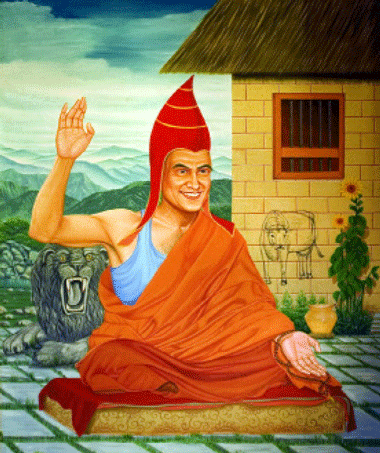
The author of this profound teaching on emptiness and the vast teaching on the qualities of the path and fruition popularly known as Madhyamakavatara (Tib: Uma-La-Jugpa) is the great Buddhist adept-scholar known as Chandrakirti, who was born in the land of Samanta in India in about the seventh century. He was an extraordinary person deeply immersed in the truth of the supreme vehicle. He obtained illusion-like concentration, by which he could obtain milk from the wall painting of a cow and thus dispel the rigid belief of beings in the true existence of phenomena.
This text, Madhyamakavatara, is the general meaning commentary which provides the overall meaning of Nagarjuna’s Root text on Madhyamika (Tib: Tsa-Shay). Indeed it is the king of all the Shastras expounding the ultimate view of the Madhyamika pioneer Nagarjuna. Later, from the division between the Prasangika and Svatantrika approaches to the Madhyamika views, it was the Prasangika teachings of Chandrakirti that came to be accepted by all the four schools of Tibetan Buddhism as the summit of Madhymika Buddhist tenet systems.
The presentation of Madhyamika teaching is actually simpler and less extensive in terms of subject matter and demonstration in this text, which is more adapted for beginners, since Chandrakirti discusses fewer arguments at greater length. Chandrakirti emphasizes at the starting point of the text that the seed and accompaniment of the realization of wisdom is compassion (the desire to release sentient beings from suffering). He states:
Of Buddhahood’s abundant crop, Compassion is the seed.
It is like moisture bringing increase and is said
To ripen in the state of lasting happiness.
Thus at first I shall laud Compassion!
The explanation of the Madhyamika view in this text is set within the framework of the ten paramitas which are correlated with the ten realization stages or Bodhisattva grounds [1. Perfect Joy, 2. Immaculate, 3. Luminous, 4. Radiant, 5. Hard to keep, 6. Clearly Manifest, 7. Far Progressed, 8. Immovable, 9. Perfect Intellect, 10. Cloud of Dharma].
In the sixth ground explanation of the main body of this treatise, logical ascertainment of the meaning of emptiness is done under two broad sub-topics viz.
- Disapproving the self of phenomena.
- Disapproving the self of persons.
- Disapproving the self of phenomena is done through the refutation of the four theories of production from the standpoint of two truths. The text says thus:
Not from self, and how from something else?
Not from both, how without a cause, can things arise?
It means that if phenomena exist inherently, they must be produced through one or another of the four ways. But as there is no such production, phenomena are not produced. They do not come into being out of themselves, from something other than themselves, nor from a combination of these modes, nor do they arise independently of causes. Therefore, phenomena do not exist inherently.
In the process of ascertaining this meaning, Chandrakirti takes into consideration the position of the Chittamatra School and other great streams of the Mahayana tradition which came into prominence after Nagarjuna’s time to establish emptiness by rational demonstrations. For instance: Chandrakiriti asks the Chittamatrins for an example of their ultimate judgement – inherently existent consciousness devoid of a (separate) outer appearance. And the example given is that of dreaming; they proclaim that while dreaming, if the consciousness were not real, it would be impossible to recall one’s dreams. But as a matter of fact, one does remember dreams and this is one of the reasons the Chittamarins believe that mind is real.
Chandrakirti refutes such statements by saying that it should be understood that just as there are no phenomena or knowledge objects as such, neither is the mind that perceives them an inherently existent entity. To background his dialectic statement he repeats Buddha’s words from the Lankavavatara-sutra:
According to the ailments of an ailing man,
The doctor will apply his doctoring.
And likewise the Buddha, for the sake of beings
Has said indeed that mind alone is true.
- Disapproving the self of person is done primarily through the sevenfold analysis with an example of a chariot.
The text says:
We cannot claim that a chariot is other than its parts,
Nor that it is their owner, nor identical with them.
It is not in its parts; its parts are not contained in it.
It’s not the mere collection of the parts nor yet their shape.
Just as the chariot is designated in dependence on its wheels and so on, the self of a person is imputed in dependence on the relatively true phenomena of empirical existence – the five aggregates, the sense powers, the six elements, and so on. Thus we can conclude that the self is a mere designation and is not a truly existing entity which is stable and immutable as we conventionally think of it.
Finally, Buddha-hood itself is made the subject of a detailed presentation at the conclusion of the text.
Wise, they enter and forsake a hundred concentrations;
A hundred worlds they have the power to shake and illumine;
With miracles they ripen to maturity a hundred beings
And journey to a hundred Buddha fields.
In its precise form, the Madhyamakavatara falls into three main sections: the homage, the main body of the treatise, and the conclusion.
Note: This excellent text is included in the syllabus of the third year of Ngagyur Nyingma Institute as one of the main subjects.
By Jigme Lhundrup
6th Year, NNI