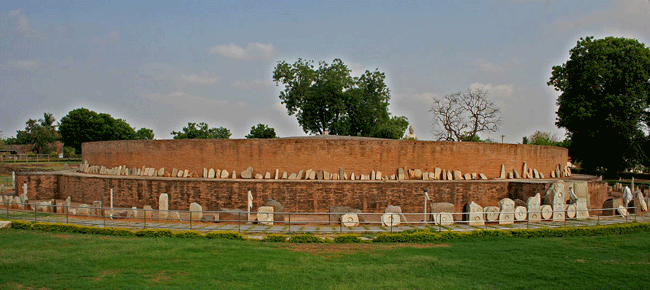
Palden Drepung or the Shri Dhanayakata Stupa is one of the oldest and most unique stupas in Buddhism. Generally we see eight types of stupas in the sutras, each related to an episode in the life of the Buddha. However in Vajrayana Buddhism, the ninth one is the Kalachakra Stupa, which has to do with ‘guarding from negative energies’. According to historians, the first Kalachakra Stupa is believed to have been built between the 3rd and 2nd centuries BCE in the old town of Amaravati, Andhra Pradesh, in southeast India. Amaravati is located a few miles away from the town of Guntur and south of the river Krishna, one of the major rivers of south India. It was constructed with bricks and marble in the shape of a dome. There are beautiful carvings inside the stupa which show the unique architecture of Buddhism, although it is not fully intact at present. Regrettably, during the period of the decline of Buddhism in India, the stupa was buried due to negligence and only ruins of it can be seen today. The stupa’s situation may be seen as a symbol of the waxing and waning of Buddhism in India. It has been noted that this opulently embellished stupa attracted pilgrims until the 12th century CE and gradually went to ruins when Buddhism declined. The stupa was renovated several times by Buddhist kings, such as Emperor Ashoka, during the period when Buddhism was at its peak.
The Buddha prophesized that the Vajrayana teachings would be widely taught by Guru Rinpoche and others after his demise. But that doesn’t mean that the Buddha himself never imparted Vajrayana teachings. As it is a highly advanced and esoteric teaching, the Kalachakra Tantra was taught secretly by the Buddha to fortunate ones. Among the Vajrayana teachings, Kalachakra or ‘Wheel of Time’ is the essence and basis of all the Vajrayana teachings that Buddha Shakyamuni taught in his lifetime. One of the texts says:
At the age of seventy-nine, in the water horse year,
In the forest of Palden Drepung,
For the Dharma king Dawa Zangpo and so forth,
I have taught the Wheel of Time.
Accordingly, it was the king of Shambhala named Suchandra (Tib. Dawa Sangpo), an emanation of Vajrapani, who requested the Buddha to give him a teaching for a practice that did not require him to renounce worldly activities. So the Buddha, on a full moon night while he was teaching the ‘perfection of wisdom’ (prajnaparamita) at Vulture Peak, was said at the same time also to be miraculously present in the midst of the mandala of Kalachakra where the great stupa of Shri Dhanayakata or Palden Drepung now stands. The Buddha abided with King Suchandra, bodhisattvas, gods, nagas, etc., in Kalachakra samadhi. The Buddha then ‘turned the wheel’ of (i.e. taught) the Kalachakra Tantra at the special request of the king.
Afterwards, the first Palden Drepung stupa in the world was erected. Since then it has become a very important monument for Buddhist pilgrims to visit and receive blessings.
The Kalachakra teaching was gradually translated into Tibetan as it reached Tibet from India. By knowing the auspiciousness of the stupa and the teachings, H.H. the 14th Dalai Lama has conducted Kalachakra initiations dozens of times, including one in Amaravati itself in the year 2006, where hundreds of thousands of Buddhists gathered to visit the place and receive the transmission. Though it had been a secret teaching, it is now taught openly to the public in the present generation, due to chances of it becoming extinct.
According to an Indian archaeological survey, the Palden Drepung stupa is one of the best and most mesmerizing architectural remains of ancient Buddhism. It is said that we can see the original broken carved pieces of the stupa in the national government museum in Chennai and also at the site museum in Amaravati. At present there are several replicas of Kalachakra stupas around the world, such as the Kalachakra stupa at Bokar Monastery in Dharamsala, India; one in southern Tibet; and one each at Karma Guen in Spain and the Kurukulla Centre in Boston.
By Padma Mani Translation Committee, NNI