

Part One
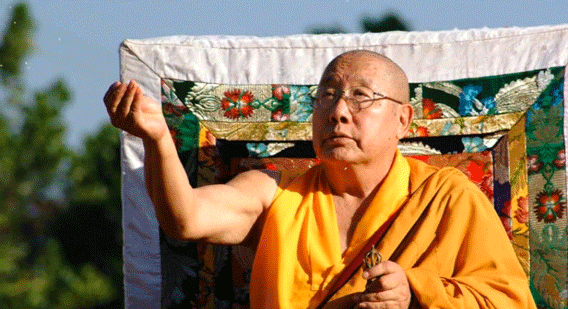
Tonight I am going to talk about the general history of the Dharma and the way we individually think. Generally, as we have attained a human form in this world, we should make this significant in whatever we do. It is also obvious that each and every human being in this world can at least acquire favourable conditions such as food, clothes and shelter for themselves. Even animals are able to take care of their basic needs. However, since we have attained this human body endowed with distinguishing attributes like the ability to speak and reason, it is important to make every action meaningful in order to obtain ultimate happiness.
In general, we can summarize all activities into two categories: dharmic activities and worldly activities. The majority of us spend our lives engaging only in worldly activities. There are various wholesome and unwholesome worldly activities according to one’s abilities. Even then, however many worldly things we accomplish, whether they are something good or meaningful, they will endure just for a few months or a few years at most. There is no ultimate fruition that we can accomplish through relying upon worldly endeavour. For example, if a child studies hard from his primary school until the completion of his higher educational level, one could say that he would have a happy and peaceful life for around twenty to thirty years if luck favours. Further, if he does his job with an altruistic intention, there is a good deal of benefit from the religious point of view. On the other hand, a person who thinks only about his own benefit will accomplish nothing worthy in this life and will face great difficulties in the future even if he is well-qualified and skilled.
However, we human beings consider our own welfare to be of the utmost importance. In this manner, we have been wandering in cyclic existence since beginningless time. No one can find out or even estimate how long we have been just drifting around in samsara. We could not count the years, even if we tried to calculate a hundred, a million or a billion, and so on. We couldn’t count how many times we have gone through the process of birth and death in one single eon; likewise, we couldn’t calculate how many eons we have been stuck in cyclic existence.
During all these ages, we have been merely yearning to make ourselves joyful and comfortable. Even in such efforts, we encounter many ups and downs. Sometimes things turn out as we wish and sometimes not. If we think about ourselves, there is similarly no one who did not think of his or her own welfare starting from birth until now. In short, whatever we do—be it education, earning money and so on—we only do it for making ourselves happy. There is no one who does it for making him or herself unhappy. Nevertheless, success totally depends on one’s karma. It is very difficult to accomplish even one percent of what we wish.
Nowadays, there are many people who don’t think about, or believe in, the causality of karma or past and future lives. This is mainly because of the inability to think more deeply and not having a relationship with Dharma. They believe only in things which reveal themselves at the moment and think there is nothing more than that. There are many reasons for this. Firstly, they do not have proper dharma knowledge; secondly, they are not able to think in the right way being unable to comprehend what is involved in past and future lifetimes. As we are fixated by ignorance, we do not have a clear concept about karma. There are many people who do not have any idea about the Buddha, Dharma or the path of liberation. They believe that all these things do not exist. Even if the masters and learned scholars teach them about karmic theory, there are only a few people who would accept it as an absolute reality. Most of them take it to be fiction or a myth.
It is a universal fact that karma exists as the common law of cause and effect of all sentient beings. One has to accept the nature of karma irrespective of good or bad. When one does not understand these deeper things, one thinks that they really do not exist. When the lamas and other teachers give teachings on the suffering of samsara, it is of course not really nice to hear, and one might feel like, “I don’t want to hear these kinds of teachings.” One might even say that these lamas do not know how to explain the meaning of Dharma.
Generally, whatever these lamas and scholars teach are not their own words. They are teaching what was taught by the Buddha himself, rather than telling lies to deceive others. The Buddha taught about the faults of samsara, as they exist in reality. The Buddha taught all these teachings initially after having attained the ultimate realization. With great kindness, he solely taught in order to liberate sentient beings from samsara and to lead them towards ultimate bliss. He neither taught for fame nor to proclaim himself as a great scholar, and certainly not to tyrannize others. For instance, a person who is sleeping and having all kinds of nightmares is very frightened in the dream itself, but when he tries to escape from all these scary feelings, he cannot wake up from that dream. At the same time, his friend who is awake and sitting beside the bed can see that his friend is having some unpleasant dream and tries to wake him up. Likewise, the different kinds of sufferings we are experiencing in samsara are just like someone having a bad dream while they sleep.
In general, our actions are categorized into those of body, speech and mind. All virtuous and non-virtuous actions arise through these three. For example, killing other beings will shorten one’s lifespan and subsequently one will have to undergo the unbearable sufferings of hell for a long time. Likewise, the result of stealing others’ wealth or possessions by negative means of oppression, robbery and cheating will consequently ripen in oneself, despite the fact that one seems to obtain something at present. As a consequence of this, one’s future will be deprived of wealth and prosperity. Regarding sexual misconduct, adultery has been forbidden primarily among lay people. This is because if adultery prevails, there will be disharmony between couples and one will not get a faithful partner in this life. Also in future lives, one will face negative consequences such as not having a harmonious family and will always be involved in disputes and hostilities.
Similarly, if we commit any of the four non-virtuous actions of speech—lying, slander, harsh words and idle gossip—it will bring adverse consequences, such as being deceived frequently, one’s words not benefiting others, and even if one speaks about something beneficial, it will turn out to be harmful, and so forth. In this way, we have to face various results in the future. If we have unwholesome concepts like covetousness, harmful thoughts and wrong views, we will experience many undesirable consequences such as not being able to accomplish anything as we wish, encountering many situations with unfavourable outcomes for ourselves, and not being able to have good relations with authentic masters and good friends, etc.
In general, all these are commonly accepted facts among lay people. However, it is our duty to amend our own nature by abandoning those ten non-virtuous deeds and cultivating virtuous ones by all means. It is said, “If we practise the human principles well, then the realms of the gods are not too far away to reach.” It is also said, “If one practices morality, it will be quite easy to enter the spiritual life.” Therefore, it is imperative to benefit others through our body, speech and mind with kindness.
Bodhichitta is the root of Dharma. If we are able to generate perfect bodhichitta, then we are approaching the path of liberation. Our bodhichitta should be totally unbiased. If we extend our kindness only to the loved ones close to us by harming those we dislike, this is not bodhichitta at all. Bodhichitta means being compassionate to all sentient beings without exception. Even creatures such as ants also have Buddhanature as their ultimate nature. There is no difference because of size or form. In the teachings it says that as there is no limit to space neither is there a limit to sentient beings. Their number is immeasurable. Hence, we have to generate bodhichitta focusing on immeasurable sentient beings. If bodhichitta is within one’s mindstream from birth, it is of course very good. If not, one should understand the necessity and importance of bodhichitta and should receive its vow. Based on bodhichitta, one can receive the Bodhisattva vow either from a holy master or from the body, speech and mind-shrines of buddhas and bodhisattvas. After receiving this, we should put it into practice. In this way, the fact that we are born as human beings becomes something meaningful.
Within our mindstreams, there are many kinds of mental afflictions and among those there are five main defilements which are known as the five poisons. These are the main causes of the extreme suffering that we experience in samsara. That’s why our central objective as a practitioner is how to get rid of this afflicted mind, how we can abandon and eliminate these poisons. In the beginning, it is really difficult to generate bodhichitta within one’s mind. But if we constantly contemplate and try to train ourselves to adopt all these practices, it will be easier and become like a habit. All buddhas and bodhisattvas of the past were ordinary beings like us at the beginning. They were not born as buddhas.
To be continued…….