According to the unique tradition of Vajrayana, there exist three great lineages of teaching in the secret mantra tradition. They are:
- The intentional lineage of the victorious ones
- The symbolic lineage of the vidyadharas
- The aural lineage of mundane individuals
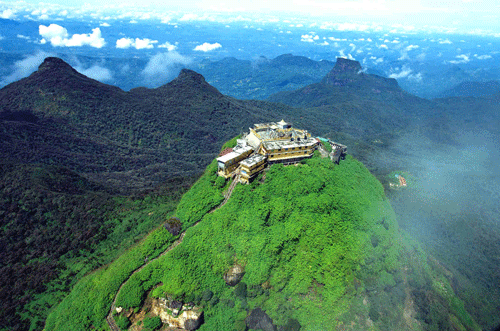
Mount Malaya—also known as Mount Malayagiri, Adam’s Peak and Sri Pada—located in Sabaragamuwa, Sri Lanka, is the place where the second lineage of the vidyadharas among human and non-human awareness holders originated.
In the Tantra of the Declaration of Enlightened Intention, a disciple asks the Buddha:
O Transcendent Lord! You have indeed taught
The three guiding vehicles.
Why, then, do you not teach the definitive vehicle,
In which the spontaneous presence
Of the cause and the fruit is enjoyed,
And which cannot be requested from other buddhas?
To this, the Buddha replies:
Having turned the wheel of the doctrine of causes
For those who are intent upon cause,
The short path of the vehicle of indestructible reality
Will make its appearance in the future.
According to this prophecy, 28 years after the Buddha’s demise, the five precious sublime ones—namely the god Yasasvi Varapala, the naga king Takshaka, the yaksha Ulkamukha, the ogre Matyaupayika and the human awareness holder Vimalakirti the Licchavi—learnt by supernatural cognitive powers about the Buddha’s entering into parinirvana. They aroused themselves from their meditative absorption and miraculously assembled on the peak of Mt. Malaya in Sri Lanka. There, they cried out in twenty-three verses of lamentation and wept to the point of exhaustion. At that time, the Buddha appeared and predicted that Vajrapani, the Lord of Secrets, who had been empowered with the secret mantra, would appear there in person. In that way, the perfect time ripened and Vajrapani appeared. He instructed the five precious sublime ones, along with numerous fortunate beings, in the sacred teachings of the secret mantra which were conferred in the Akanistha heaven and other places by the Buddha. Matyaupayika inscribed them in a golden book with melted beryl and then with the seven intentional powers the book was concealed invisibly in space.
The land of Lanka, where Mt. Malaya is situated, is an island isolated by the ocean off the southeast coast of Jambudvipa, where, on an invitation from Ravana—the ten-headed lord of Lanka—the Buddha came and taught the extensive Sutra of the Descent to Lanka at the request of Mahamati. Later, the country was seized by the merchant Sinha, and today it is called Sinhala. Subsequently, when the great master Kanhapada went there, he subdued a great ogress called Visvarupi and propagated the mantra teaching. It is said that the master of the greater vehicle, Lankajayabhadra, was born there. Renowned masters like Chandragomi, Santipa and the great scholar Vanaratna also visited the place and propagated the mantra teaching.
As Mt. Malaya is surrounded by a chain of rocky hills, no ordinary person can reach there. The great master Padmasambhava and his disciples went there and stayed for six years before returning to India. The mountain is usually known by the aforementioned name and possesses all the qualities of Mt. Malaya, which is a ferocious wilderness as described below:
On its peak dwells the king of powerful craft.
On its face is a dog-shaped white rock.
It’s adorned with the likeness of a lion, leaping through space.
At its base grow eight medicinal roots;
Illness and disease do no harm here.
On the summit there is the eyrie and nest
Of the solitary Kalantaka bird,
Which dwells apart from all others.
The peak is of easy access to the fortunate ones,
But is completely impregnable to the unfortunate ones.
Lanka is an eminent place of various praiseworthy qualities. Near the base of the mountain there are many stupas containing relics of the Buddha and one of them is known as the great stupa of Gunavera. On its western side, there is a tree called Buddhasarana under which the Buddha remained in contemplation for seven days. Sinhala’s rivers are filled with pearls, treasures and other precious jewels. The forests are filled with endangered animals like elephants, and houses with voluptuous girls.
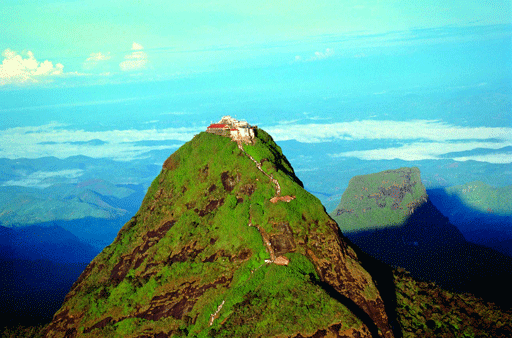
In a dense forest called Kandala in the northeast, there is a cavern which houses Sripaduka, an enormous 5-foot, 11-inch footprint1 of the Buddha which he left during his third visit, during which he was accompanied by twelve thousand monks. The teachings of both the lesser and greater vehicles were widespread during ancient times and are still growing.
Pilgrims are allowed to visit only from the beginning of December till the end of April as the place is mostly under thunderstorms and heavy rainfall. The mountain is at an elevation of 7359 ft. Visitors have to make journey by walking at night. It takes five hours or less for fast walkers to reach the peak and slower ones might take around seven hours. Lamps along the footpath are lit for the visitors.
Mt. Malaya is one of the world’s most auspicious pilgrimage sites, especially for Buddhists. Pilgrims risk their lives walking thousands of steps up the mountain in spite of the difficult routes. The most amazing scene of the peak can be seen during sunrise, when the distinctive shape of the mountain casts a triangular shadow on the surrounding plain. Climbing at night can also be a remarkable experience, with the beautiful lamps lit on the path leading up and into the stars overhead. There are rest stops on the way where one can relax and enjoy the fresh air.
Note: The above verses are taken from Dudjom Rinpoche’s The Nyingma School of Tibetan Buddhism and its Fundamental History translated by Gyurme Dorje and Matthew Kaptsein.
By Tenzin Dorji
8th year, NNI