
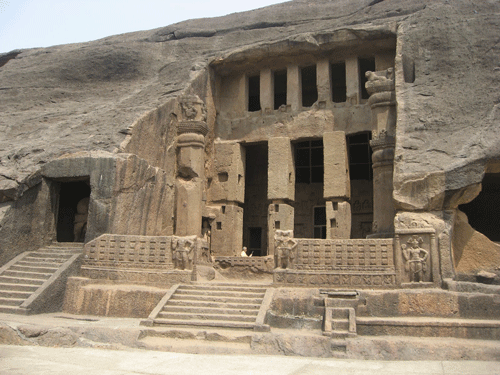
According to the Archaeological Survey of India, there are many historical sites which demonstrate the Buddhist influence on its arts and culture during the medieval period. Due to our busy life and lack of interest, however, many of these sacred sites are still unknown to us. Many remarkable beings of the past meditated and became enlightened at these places. Nowadays, most of these Buddhist sites remain only as tourist spots instead of sacred holy destinations. Among these, the Kanheri Caves, located at Sanjay Gandhi National Park, Borivali, Mumbai was one of the most renowned meditation centres for Buddhist tantric practitioners from the 1st century BCE to the 19th century. Stone and copper inscriptions that are found in the caves are in the Brahmi, Devanagari and Pahlavi languages. These indicate that the inscriptions inside the caves were carved during the Mauryan and Kushana periods.
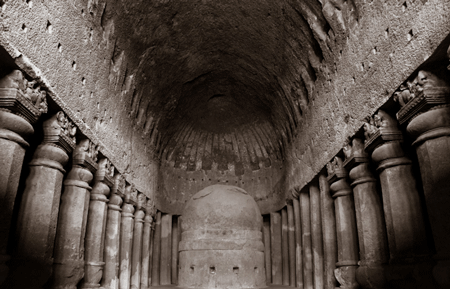
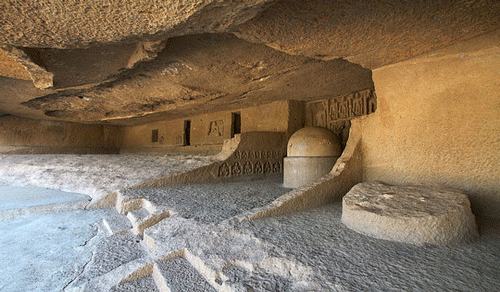
The word Kanheri comes from the Sanskrit Krishnagiri, which means ‘Black Mountain’. There are 109 caves in total, all carved inside the basalt rocks in the middle of a hilly forest on the western Konkan coast. These caves were carved as hermitages by the Buddhist tantric practitioners, intended for living, study and meditation. This establishment at Kanheri has got some interesting monuments in the form of small structural stupas and many other clay tablets, inscribed with characters from Buddhist scripture. Furthermore, some caves have magnificent sculptures of goddess Tara and goddess Bhrikuti with Avalokiteshvara, the compassionate Buddha, at the centre. These are indicators of the exquisite arts of that period. On the outer sides of the walls, there are many intricately carved sculptures of Buddha and Avalokiteshvara’s manifestations. Some caves are large in size and it is said that these were especially used for congregational worship by the monks. The statues lining the inside of the caves contain the relics of the Buddha and bodhisattvas which make this site more sacred and holy. Other small caves used to be the dormitories for the monks and each of them consists of a small worship shrine and rock-cut beds. For the further betterment of monks’ lives there, a cistern system was designed.
At the time many Buddhist scholars from Nalanda used to come to Kanheri to practice tantra. It was a home for many great yogis and yoginis who later attained Enlightenment in these sacred caves. In the late 10th century, one of the most renowned Buddhist masters of that time, Atisha Dipamkara (980-1054), came to Kanheri from Nalanda by following the instruction of his teacher Audhutipad to learn and practice tantra from his spiritual master Arya Vajrayogi. In these caves, he received the empowerment of the Hayagriva Mandala and transmission of the Hayagriva practice from Rahulagupta. The sacredness of this site has been described in many biographies of the great Indian and Tibetan spiritual masters.
When French occupation forces entered through the western coast and started dominating the place, they forced the monks to convert the Kanheri Caves into a church. After that, the number of monks became fewer and when the Mughal dynasty came into power they started destroying the site.
The remaining ruins of these caves in the hilly forest of the present day Sanjay Gandhi National Park, Mumbai was left unknown to the world until the Archaeological Survey of India started taking care of this site.
By Gyaltsen Tamang (Sudeep)
7th year, NNI