Palyul Ling Retreat Centre in New York, USA
It was probably about May when I thought something felt different about this year’s Summer Retreat, Sangay Lakchang (Liberation in the Palm of Your Hand). I realized later actually things had been different much longer from what I usually experienced as one of the office volunteers. It started with our receiving a single stray application in January from someone new wanting to attend the retreat, long before registration normally opens. By May I started thinking, “Wow, we have a lot of registrations this year!” By June when we were really having to work hard to sort out and organize rooms for people to stay, I knew, including last-minute registrations, we would be very crowded at our Summer Retreat in 2015. Very crowded indeed.
You may be surprised to know the first retreat His Holiness Penor Rinpoche held after he established the Palyul Ling Retreat Centre in McDonough, New York, in 1998, was not very crowded. But that was simply because people in the United States didn’t know about us yet and there weren’t many American Buddhists. I myself barely understood who His Holiness Penor Rinpoche was; I just had a sense he was amazing and great. When His Holiness decided to move forward with a retreat centre, I actually had doubts. I felt surprised when I saw progress to the goal wasn’t going to be slowly, slowly, kalay, kalay. It was going to be right away. Now, “ASAP!” as His Holiness’ long-time monk worker at the retreat centre, Lama Tsewang Norbu, always says to me.
When His Holiness instructed Lama Lobsang Chophel, Namdroling’s late treasurer, to arrange to have a one-month retreat immediately, he pressed forward quickly with a land purchase in a rural area. With few sponsors in the USA, he raised funds in Asia. Unlike other masters with centres close to major cities, founding a centre in a rural area allowed us to avoid a very lengthy permit process. Lama Lobsang, my husband and I rushed and were able to send out a flyer and advertisements about the retreat, but still only published them eight weeks before the start date. For Americans, this is very short notice for a one-month retreat as our culture is so focused on work we are barely allowed time out for one- or two-week vacations. Yet about 35 lucky people signed up for the one-month retreat to receive Ngondro and the Nyingma Kama directly from His Holiness, translation and commentary by Khenchen Tsewang Gyatso, and a teaching on the Four Nails. Student accommodations, the temple, dining area and kitchen were held in tents. His Holiness’ residence with the monks was a simple farmhouse five minutes down the road, across the street from an old dairy cow barn and chicken coop.
Palyul Ling is now situated over 500 acres of beautiful land, with streams, ponds, forests, electricity and simple farm buildings. It’s remote, from an urban American point of view—off of a dirt road—yet still with broadband internet access and half-hour proximity to good shopping. Getting to the centre is a reasonable drive from many highly-populated areas—New York (4 ½ hours), Cleveland, Ohio (5 ½ hours), Toronto, Canada (5 hours), and Washington, DC (5 hours).
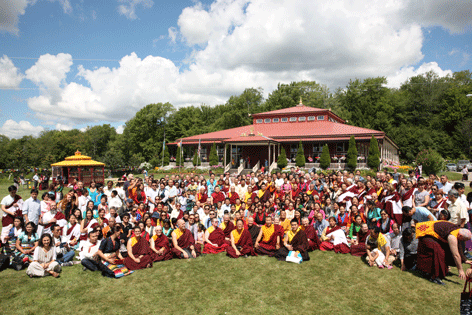
In 1998, with the exception of Kunzang Palyul Choling in Maryland (close to Washington DC), no Palyul centres had yet been established in these cities. Now, major centres exist there as well as in California, Montana, Florida, Texas and other states, as well as Ottawa, Canada. And from an initial batch of “a thousand Tibetans” accepted as refugees by the United States, the area is now residence to several thousand Tibetans, Bhutanese, Nepalese, Sikkimese and others, particularly in New York and Toronto. Over the years, the number of attendees has also grown from our initial batch. Since 1998, we have grown to average 120 people in residence a day, with up to an additional 20 weekend guests.This year was different. In 2015, we had an average of 190 people, full time, per day. On weekends, 25 people or more would arrive. And, on the last weekend, August 8 and 9, so many people arrived for the final events with H.H. Karma Kuchen Rinpoche they were piling up in tents with their friends, sleeping on the floors of the dormitories, and putting sleeping bags in the tool sheds. On the last day endless cars arrived and five busloads of people came for the Tse-Wang (long life empowerment). The temple was packed to overflowing. This year was the largest retreat we’d ever had.
Every year we follow a schedule H.H. Penor Rinpoche established. The students arrive on July 8 and 9 and get settled into their accommodations; simple platforms with alpine tents, one of the two low dorms near the temple or the two-storey, comfortable dorm His Holiness had Lama Tsewang build in 2007.
The night before retreat officially starts on July 10, Khen Rinpoche gives an orientation to the newcomers, who may not be at all used to how to behave around monks and nuns or in a temple, to learn a lot of details of our tradition and other matters including “rota.” “Work rota” is a system whereby each student must take a humble job—such as cleaning dishes, chopping food, or even taking out garbage and cleaning the restrooms. Each and every student must help in some way, no matter his or her rank.
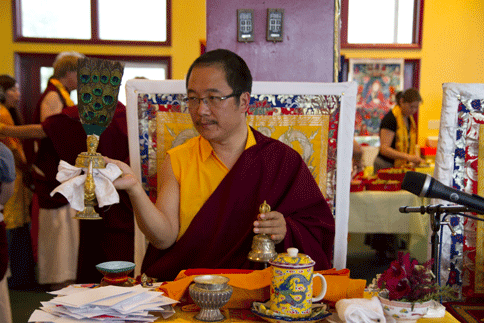
H.H. Karma Kuchen Rinpoche and His Eminence Gyang Khang Khentrul Rinpoche alternate each year taking on the responsibility to lead the retreat. All three heart sons, including Mugsang Kuchen Rinpoche, join the retreat every year to give their blessing. This year was His Holiness’ turn to lead us as retreat master. We have a grand opening puja on July 10; empowerments are held on the weekend. This year in addition to the usual Tsalung and Tögyal empowerments (Throwo Rosa and Rigpa Osal) we received Vajrakilaya, Tara, Zhithro, Chenrezig, Guru Rinpoche, Amitabha, and, of course, Long Life empowerment. Further, His Holiness granted the Ladrub Thigle Gyachen, a rarely-granted empowerment from the innermost lama practice of the Longchen Nyingthig. The retreat ends on August 10, with a mandala offering to the retreat masters, trying our best to follow the procedure exactly as if we were doing it in Namdroling itself.
While H.H. Karma Kuchen Rinpoche granted the empowerments and checked the accomplishment of the Tsalung students. Khenpo Tenzin Norgay Rinpoche taught Ngondro, Tögyal 1 and Tögyal 2. Tulku Dawa Gyalpo Rinpoche from the Toronto, Canada, centre taught Tsalung Tummo. Khenchen Tsewang Gyatso taught Threkchö 1 and Threkchö 2, and gave pith instructions to those who had completed up to the eighth year. There are students in those classes who spent their first months for each of the seven years of classes directly instructed by H.H. Penor Rinpoche.
We are fortunate to have the monks who spent years close to and serving H.H. Penor Rinpoche day-to-day in his zimkhang lead the actual practice sessions for our classes. Lama Pasang Tenzin leads Ngondro and serves as umze (the chant master). Normally Lama Rapjee Wangchuk leads tsalung, but this year could not due to an injury. Huang Chin, from the 1998 batch and his long-time student, expert in tummo, guided that practice. Lama Phurba Tenzin who served His Holiness Penor Rinpoche personally in his household for so many years, now leads the third class and serves as chopon. The fourth year (Tögyal 2) is led by another from His Holiness’ household, Tenzin Chögyal. The fifth year had been led by Lama Samten before he went into Losum Dasum (three year, three month retreat), but this year was led by Lama Rapjee with help from visiting Lopon Dorje Khedak. The sixth year practice (Threkchö 2) was led by newcomer Lopon Pem Tsheri. For our seventh and eighth year, Dorje Lopon Lama Sochuk, resident monk at our centre, leads, this year with help from a special guest from Singapore, Lama Samten Phuntchok Rinpoche. Helping with the pujas was Khen Rinpoche’s nephew, Lama Jigmey, as well as Lama Ogyen Randrol (who as Cham Master leads our end-of-retreat lama dance), Lopon Sonam Dhendup, and Lama Thubten Tashi.
The first year Palyul Ling offered tsalung was in 1999, the second year of retreat. The monks were very surprised to find Americans bringing notebooks and noting down all of the secret teachings, listing out the exercises instead of just memorizing them. “Hey Mary,” one of our monks joked. “Did you tell them about the notes-burning party we’re going to have later?”
But slowly our American style was accepted. Over the years these notes became more formal if not official, and reviewed and edited by our teachers. This year, H.H. Karma Kuchen Rinpoche decided to make them official and oversee their editing himself, making sure they were precisely correct according to our lineage and teachings. Tulku Dawa Gyalpo Rinpoche was the primary tsalung teacher, but H.H. Karma Kuchen Rinpoche would join the practitioners in their hut and double-check very subtle details on the exercises when they were introduced. The notes for each set of exercises was edited and re-edited, with help from Dr. Keith Curtis, to be sure they precisely expressed what the practitioner needs to follow.
In the same way H.H. Karma Kuchen Rinpoche pursues every detail of the retreat with precision and care. For tsalung, he worked very closely with a pecha (Tibetan text) from Tibet and consulted closely with Khenchen Tsewang Gyatso, who oversaw the updating and correcting of particular English words. Tulku Dawa Gyalpo, when giving explanations, followed in this style, with two translators at the teachings determining which precise word exactly expressed the meaning in our texts.
Our retreat is staffed year round by three monks. Dorje Lopon Lama Sochuk maintains the practices in the temple, practising solkha on a daily basis and leading practice for visitors. Lama Tsewang Norbu has served His Holiness Penor Rinpoche with tireless devotion, living at the centre since 1997. Lama Tsewang is now assisted by Lama Kunsang Wangdi of Pema Kö. Lama Kunsang, taking parts of the centre maintenance as the amount of work has increased: structures include the temple, dining hall, three dormitories, six huts for tsalung and dzogchen, as well as five residences for teachers.
So many volunteer their time to help carry through our retreat, I’d like to share the names of those who helped this year so you can join me in rejoicing in their merit. Anyone I miss should know they are automatically included. We are grateful to receive instructions and guidance in our work from Khenpo Tenzin Norgay Rinpoche and Lama Tsewang Norbu. Mary Waters, from the 1998 batch, helps us yearly with maintenance. Cha Chao, who started in 2000, manages shopping for tsok and many other errands for the lamas. Keith Matis, who started in 2001, leads announcements in the mornings and helps solve retreatants’ needs. Tulku Ajam Rinpoche wrote the program we use to manage the retreat, which uses the same ID system we use at Namdroling, and continues to advise us from Taiwan. Hsiao Wei, also from the 1998 batch, and tummo Huang Chin’s wife, helps with accounting. Mooi Woong prepared our meals. Christine Lennard, at the retreat from Australia, and Tulku Chonjur Rinpoche’s sister Tsomo Gundhatsang ran our bookshop. Ling-Ling Ni helped with kitchen purchases. The nuns from Jetsunma Ahkon Lhamo’s centre, including Ani Miranda, helped us with the temple. American monk Konchog Norbu helped with private audiences with the teachers (what Americans call “interviews.”) Ani Palmo Corbus, one of our own nuns, makes sure we can hear everything that is said as the one in charge of our audio-visual system. Lama Tashi, a Chinese student from Taiwan, translates the teachings into Chinese over a headset system. With H.H. Karma Kuchen Rinpoche and other Palyul lamas followed by so many Chinese students, this is very important. We are very fortunate that a real medical doctor, Dr. Mary Young, has taken on responsibility for first aid on the retreat site.
Sitting in the office a few weeks after retreat, alone, quiet, with empty dorm rooms above my head, Lama Kunsang Wangdi out in the field mowing grass, Lama Tsewang Norbu down at the residences repairing a broken faucet, Lama Sochuk in the temple practising solkha, it came to me while this year was different in terms of numbers of people, in the end, it was indeed the same. “He is the same as me,” said H.H. Penor Rinpoche of H.H. Karma Kuchen Rinpoche in 2007. His Holiness established this retreat, the teachings have spread and we have increasing numbers of American Buddhists as a result. And with kindness, ensuring we have exactly the teachings our great masters have passed down to us for generations, H.H. Karma Kuchen Rinpoche, His Eminence Gyang Khang Khentrul Rinpoche, and His Eminence Mugsang Kuchen Rinpoche, with the help of Khenchen Tsewang Gyatso, are making sure that we have the same teachings with the same taste. We are the same as our mother monastery in Palyul, exactly as the previous H.H. Penor Rinpoche would have wished. Now we prepare for our new Yangsi Rinpoche and so our retreat will be exactly as he wishes. Authentic. Pure Palyul.
By Mary Pratt
NYC