Origination
The Indian Sutras, written on cloth were transmitted to other regions of the world. These sutras, written on banners, were the origin of prayer flags. Legend ascribes the origin of prayer flag to Shakyamuni Buddha, whose prayers were written on battle flags used by the devas against their adversaries, the asuras. The legend may have given the Indian bhikku a reason for carrying the heavenly banner as a way of signifying his commitment to ahimsa. This knowledge was carried into Tibet in around 800 AD, and the actual flags were introduced in around 1040 AD, where they were further modified. The Indian monk Atisha (980 – 1054 AD) introduced the Indian practice of printing on cloth prayer flags to Tibet and Nepal. From then the noble practice has been carried out by Buddhist practitioners until the present all over the world.
Description of the symbols in the Lungta Prayer Flags:
Outer Level: Mythical Creature
On the outer level, the Lungta is a mythical creature from pre-Buddhist times that combines the speed of the wind and the strength of the horse to carry prayers from earth to the heavens.
Inner Level: Positive Qualities
Lungta is associated with positive energy or ‘life force’ and with ‘good luck’. It is both the subduer of evil and the vehicle of enlightenment.
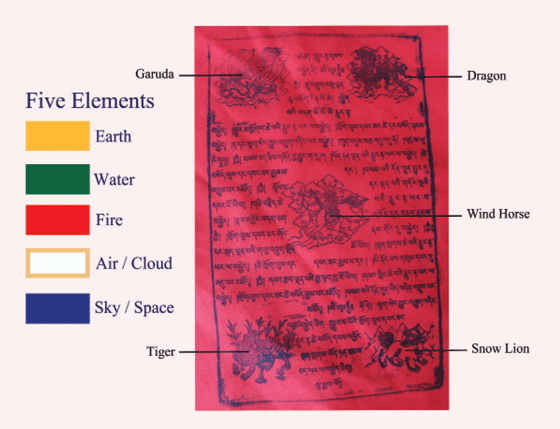
The Lungta symbol is often depicted on prayer flags, which are flown to generate merit and increase one’s life force. Lungta prayer flags typically display a tiger, a snow lion, a garuda, and a dragon, (the four dignities) with a lungta in the center. Certain lungta prayers also refer to these four symbols.
The tiger, snow lion, garuda, and dragon are ancient symbols of the qualities of lungta that originate with pre-Buddhist Tibetan and Chinese astrological traditions. Generally, they symbolize fearlessness and resilience.
Secret Level: The Space Element
At a deeper level, the Lungta and the four dignities symbolize the play of the five elements, out of which all phenomena are formed. The lungta symbolizes space, the ground of all manifestation. The Tiger symbolizes the wind element; the Snow Lion, Earth; the Garuda, Fire; and the Dragon, Water. Traditionally, they are set out in the same configuration as the five-part Mandala used for the five Buddha families, as can be seen in Lungta prayer flags.
Most Secret Level: The Inner Air or Wind
In Tibetan Buddhism, the mind is seen as being dependent on, or mounted on the subtle energy or inner air or wind within the body. This subtle energy is therefore called the ‘wind-horse’, in Tibetan Lungta. Whether the wind-horse is strong or weak determines whether positive or negative tendencies dominate the mind. On an everyday level, the wind-horse is also very much linked to what is commonly known as ‘good luck’.
Places of Hoisting
Lungta prayer flags are commonly hung on a diagonal line from high to low between two objects (e.g., a rock and the top of a pole, etc.) on places such as the tops of temples, monasteries, stupas, and high mountain passes, etc. They are sometimes erected on the ground, along riversides, cairns, and rooftops.
Timing of Hanging and Taking down
Some believe that if the flags are hung on inauspicious astrological dates, they may bring negative results as long as they are flying. The best time to put up new prayer flags are in the mornings of sunny or windy days of auspicious astrological dates.
Generally, old prayer flags are replaced with new ones annually on the Tibetan New Year.
Benefits of Hoisting Lungta prayer flags
Traditionally, Lungta prayer flags are used to promote peace, compassion, strength, and wisdom. The flags do not carry prayers to gods, a common misconception; rather we believe the prayers and mantras will be blown by the wind to spread good will and compassion into all pervading space. Therefore, prayer flags are thought to bring benefit to all. For instance, if a prayer flag is hoisted near a river or on a high mountain, even the tiniest insects and animals in and around that surrounding area will be blessed with the bliss of the prayer flag’s blessings.
By hoisting prayer flags in high places, the blessings depicted on the flags will be carried to all beings. As wind passes over the surface of the flags which are sensitive to the slightest movement of the wind, the air is purified and sanctified by the Mantras.
The written prayers of the flag become a permanent part of the universe as the images fade from exposure to the elements. Just as life moves on and is replaced by new life, we renew our hopes for the world by continually mounting new flags alongside the old. This act symbolizes a welcoming of life’s changes and an acknowledgment that all beings are part of a greater ongoing cycle.
Note:
Because the symbols and mantras on prayer flags are sacred, they should be treated with respect. They should not be placed on low and dirty ground or used as clothing. Old prayer flags should be burned or placed on high clean areas.
By Jigme Lhundrup
6th Year, NNI