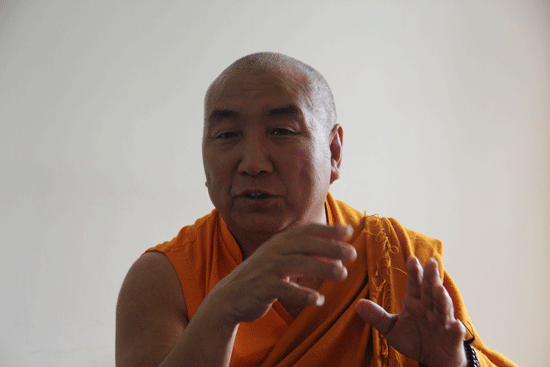
Palyul Times (PT): Tashi Delek! Khen Rinpoche. With due respect and your benevolent consideration, we the members of the Palyul Times would like to take this special opportunity to receive your golden words of experience based on your lifetime spiritual endeavour through the following interview with the altruistic aim of guiding our beloved readers on the path of dharma
PT: As Khen Rinpoche was brought up under the compassionate guidance of His Holiness Drubwang Pema Norbu Rinpoche from a very young age, can you kindly relate the sequence of events that brought H.H and yourself together?
Khen Rinpoche Namdrol Tshering (KNTR): When I was thirteen years old, H.H. performed my first hair cutting ritual and bestowed me the name Thubten Pema Singye. During that time H.H. lived in a Tibetan settlement camp and there were only a few monks. Our class room was near the residence of H.H. and my first studies were reading and writing Tibetan scriptures. H.H. himself taught me the skills of reading and the text he used was the ritual text of Karling Zhithro (text discovered by Karma Lingpa). While teaching us to read the text he explained almost the whole contents of the text. The contents ranged from the difficulties of attaining the precious human form endowed with the freedoms and endowments, to the practice of the Guru Yoga. In the process of expounding these teachings, concerning impermanence, the defects of cyclic existence and so on, H.H. used to enquire about our feelings, asking: “How do you feel while hearing these teachings?” In short, this is how the link between H.H. and myself began.
For over a year our only classes were reading and writing. Of these, reading was given priority. After a year we were also taught the ritualistic arts and by that time we were around fifteen monks in total. During the weekends H.H. used to take us for walks through the forest along the stream near Kushalnagar, and let us swim and play leisurely. Well, to put it in a nutshell, we were taught everything starting from maintaining a hygienic body.
About a year later, as H.H. became busy with the construction of the monastery he assembled all the monks and appointed the elderly Lama Sonam Tenzin of Palyul as our tutor. He was well versed in philosophy as well as in ritualistic arts. He was indeed a genuine practitioner.
These are my memories of how H.H compassionately nurtured me from the beginning.
For the next three years I studied reading and writing exclusively. When I was around fifteen or sixteen years old H.H. said that as a genuine preliminary practice, we have to perform five hundred thousand accumulations and purification practices. Thus he began to give us the teachings on preliminary practice from ‘The Words of My Perfect Teacher’. We were only around twenty monks receiving the teachings. In particular, when we were taught the lessons on taking refuge and generation of enlightened mind, H.H. gave us summarized notes he had written. These contained the essence of the practices, such as how to visualise the accumulation field, mind training with the four immeasurable and the practice of equalizing and exchanging of oneself with others. During the nights of a month of mandala offering sessions, H.H himself led us in performing the “chod” (a form of Tantric meditation introduced by the female siddha Machig Labdron, which involves offering one’s body to demons in order to exorcise them) as the chant master. It was done through the ‘Chodyul Khandro Gegyang’(chod practice revealed by Jigmed Lingpa).
In the case of Guru Yoga practice, though the actual number recommended for the recitation of the Vajra Guru mantra was ten million, during our time H.H. specifically told us to recite the Seven-line prayer of Guru Rinpoche one hundred thousand times at first. Then we were told to take a vow to recite Vajra Guru mantra at least one thousand times daily. He said that if we miss reciting even for a day and then supplement it by reciting four or five thousand times the next day, it is not acceptable. In short, he let us take this vow of recitation and assured us that if we continue with this recitation daily, then there will be no obstacles for dharma practices throughout our lives.
After that, I began to study the great philosophical treatises. At first, when Khen Rinpoche Pema Sherab was invited as the teacher of our monastery, I studied Tibetan grammar and other minor treatises like the precepts of taking refuge and so on. Then Sakya Khenpo Khedrub was invited from whom we received teachings on many great treatises like the Ornament of the Middle Way, the Summary of Tenets, etc. Although Khenpo Khedrub was a Sakyapa, he had received the complete transmissions of the Thirteen Treatises from Khenpo Zhenga, a great Nyingmapa scholar. Later, when Ngoshul Khen Rinpoche visited our monastery, we were granted the opportunity to receive teachings such as the Praise of Transcendental Qualities, the Conduct of Bodhisattvas and other minor treatises.
As H.H. cherished the noble objective of establishing a great institution for learning and practice in Namdroling monastery from the very beginning itself, we were always blessed with the opportunity to receive teachings whenever Ngoshul Khen Rinpoche, Khen Rinpoche Pema Sherab and others visited our monastery. His Holiness always requested them to bestow teachings during their stay. But during those days, on one hand, the students were unable to put continuous effort into their studies, and on the other hand there were not as many teachers as there are today. Even those visiting Khenpos did not have much time to stay here. With such problems the teaching session could not go on for the whole year. H.H. was often disappointed about this and even told me personally that it was very difficult to establish a great institution as he wished.
As H.H. realized that it was very difficult to establish a major institute with invited teachers from outside, he told me, “Now I am relying on the hope of establishing an institute by sending our own monks to study outside to learn to teach and hold responsibilities in our monastery in the future”. Since H.H. shared with me that dream with great hope, I developed the ambition to fulfil his noble wishes. Ngoshul Khen Rinpoche also gave me guidance about going to study with Khenpo Dazer in Bhutan, Khunu lama Tenzin Gyamtsho and with Khen Rinpoche Tsundrue in Sikkim. Among these, H.H. told me about the advantages of studying with Khen Rinpoche Tsuntrue in Sikkim, as he was administrating the Buddhist College of the Sikkim government.
Eventually, in accordance with His Holiness’ guidance, I went to Sikkim for studies. When I was leaving, H.H. advised me, “In the future after studying well, try to be able to hold the responsibilities of our future institute in this monastery and come back annually to spend your vacation for at least a month or two”. Thus, I spent five years studying in Sikkim.
In the meantime, Khen Rinpoche Tsundrue had the intention to move to a bigger monastery, and coincidentally, H.H. also sent him several invitation letters inviting him to Namdroling Monastery. Finally I managed to invite Khen Rinpoche Tsundrue to Namdroling monastery. Although Khen Rinpoche came to the south to treat a health problem and not to establish an institute, he was greatly moved after he noticed the great enlightened activities and noble intentions of His Holiness. Khen Rinpoche said that although he would not be able teach for a long period of time due to his old age, Namdroling would surely succeed if he inaugurated an institute, since everything turns out well for him because of his good karmic fruition. He also told me that the continuation of the academic sessions could be maintained by Khenpo Pema Sherub and me. Khen Rinpoche told me to inform His Holiness about his wish. Accordingly, I conveyed the message and H.H. too was pleased with this decision.
I don’t remember the exact year, but it was on the 10th of the first Tibetan month that the first teaching session of the Ngagyur Nyingma Institute was inaugurated, and held its first teaching session. It was conducted in a small class room on the top floor of our old temple, where we prepared a throne for Khen Rinpoche and even H.H. himself attended the class with us. During that initial year Khen Rinpoche Tsundrue bestowed the teachings on the lessons which are included in the present 1st year syllabus and I taught the revision class as a teaching assistant. At the same time I also took the responsibility of disciplinarian and the first year was completed in this way. The construction of our hostels was also begun at that time. In short, these are the sequence of events in my relationship with His Holiness.
PT: Khen Rinpoche, as you spent many years with H.H., can you briefly highlight us about extraordinary qualities of H.H. from your point of view?
KRNT: As you all have said, most probably I might be the person who had the most intimate relationship with H.H. in this monastery, because as I have already mentioned above I was brought up under his guidance from the age of thirteen. In fact, the enlightened activities and qualities of H.H. are not something which can be understood by a person like me. Although earlier I didn’t see anything extraordinary in the way H.H. performed his activities, now when I really examine them, they are all transcendental, far beyond our perceptions. Such activities are certainly the enlightened activities of a highly realized being.
To mention a few examples: In 1959, when Tibetans fled to India due to the Chinese intrusion, H.H. also fled to India facing all the difficulties almost empty handed. H.H. lived for some months at the beginning in a place called Balingpur in Assam. A large group of refugees was assembled there and it was at that particular place where I and my family members met H.H. for the first time. During that period, at least three or four Tibetans were dying daily due to the intense heat in India as they had descended from a very high altitude. H.H. was the main lama who performed the rituals like transference of consciousness, and so forth for all the deceased. Though most Tibetans had a very difficult time earning a livelihood, H.H. continuously went out to perform local rituals day and night without any rest. Sometimes, when there was a seriously ill patient, H.H. would go and help them even at midnight. On those occasions I accompanied His Holiness as his assistant several times. When performing the ritual of transferring the consciousness, H.H. left none without the signs of transference mentioned in the tantra texts. As it was a very difficult time, people had little to offer for his great service. Even if they did make offerings, he would not accept them and simply put them below the table in front of his seat. This is what I personally noticed while serving H.H. as an attendant.
Gradually, H.H. moved to South India. He arrived in Bylakuppe in 1960. During those days, H.H. lived at First Camp in a bamboo hut allotted by the Indian Government along with other Tibetan refugees. During that period, H.H. began to conduct the 100 million recitation accomplishment, which is performed annually in our monastery today. It was conducted in a huge bamboo hut by his entourage and other monks. At His Holiness’ behest, people were also given a teaching on the Conduct of Bodhisattvas by a Sakya Khenpo who was residing in the region.
In 1963, H.H. laid the foundation stone of Namdroling monastery. If we think of the condition of the livelihood of that period, it was almost impossible for anyone to have a thought of establishing a monastery. He had nothing more than the clothes he was wearing. It was in such a difficult time that H.H. began to establish our monastery. During those days, everybody relied solely on agriculture for their livelihood. H.H. used to perform rituals for rain whenever the rain failed to come on time. Sometimes, when there was severe drought and he could not bring the rain by rituals performed in the monastery he would go to the Betapur hill top and perform the ritual for several days until the rain fell. After H.H. went out and performed the rituals for sure the rain would fall. This is something I have noticed personally, for I went with him as attendant several times. He also accomplished treasure vases and distributed them free of cost among the people, for the wellbeing of the place and the people. However, out of religious partiality, some people blindly said that distributing treasure vases was merely a mode of deceiving common people; and the rain falls when the season comes, so the rituals for bringing rain are useless. Hearing this, H.H. was greatly disheartened and stopped performing these services for almost a year. Consequently, the common people suffered a lot. They didn’t have enough agricultural products as there was a severe drought for nearly the entire year.
To come back to the establishment of a learning Institute as spoken about earlier, although Khen Rinpoche Tsundrue was invited to our monastery, H.H. realized that the result of Khen Rinpoche’s hardships in bestowing education would not be satisfactory as there were only a small number of monks. Therefore, he planned to invite aspiring students from other places and provide accommodations and food by himself. Initially, he had planned to accommodate at least one hundred monks, which was really a huge gathering at that time. However, over time the number gradually rose higher and higher and finally he aimed to provide learning opportunities for five hundred monks. In general, although there were great economical setbacks, H.H. continued to work with strong determination and unshakable mental strength, despite all the hurdles.
Regarding the Institute, His Holiness stated: “This is a Nyingmapa institute, so no one is allowed to create disagreement among the religious sects by saying, I am a follower of Palyul, I am a follower of Zhechen and so on”. Thus, he named it the Ngagyur Nyingma Institute. Unlike today, many students came from Sakya and Kagyud to study in our monastery. The Institute’s curriculum was designed by Khen Rinpoche Tsundrue and approved by H.H. when it was presented to him. Unfortunately, Khen Rinpoche Tsundrue passed away before long. During that time, we didn’t feel much about this, but H.H. was really saddened and said: “Although I have great enthusiasm to render service to Buddha-dharma, there are always some obstacles following it. So I think it will probably not work now”. With such words, I saw him weeping several times in his chamber. If we judge him by all these actions, it is very easy to understand how great his intentions and activities were.
PT: As the number of people becoming Buddhist is rising in today’s world due to improved awareness, can you give some important instructions to those beginners?
KRNT: It is really true that the Buddha-dharma is spreading pervasively in the present world. It is an undeclared fact that one will gain more and more faith and confidence in Buddha-dharma as one analyzes more with logical reasoning, for Buddha dharma solely deals with the infallible truth. Therefore, it is very important to study the Buddhist philosophy. In case one cannot study properly and lacks proper understanding of the intrinsic meanings taught in Buddha-dharma, it is possible to lose faith and deviate from the path. Thus, the main thing is to study well at the beginning. It is very beneficial in this and future lives if you can merge the meaning of the texts into your mind stream and practise well. Therefore, I consider it imperative to listen and contemplate at the beginning as a mode of entrance into whatever path one aspires to practice, be it sutra or tantra.
PT: Khen Rinpoche, can you give some instructions for lay practitioners on how to practise dharma along with their daily activities?
KRNT: Not only Tibetans, but almost all the people residing along the chain of Himalayan ranges are Buddhist by birth as Buddhism is their ancestral religion. They have faith in it. In general it is very important to study dharma before practicing, but it is very difficult for those lay practitioners to study the profound and vast meanings of the texts. Even so, one must receive the vow of refuge on entering the Buddhist path as it is the entrance way. With this as the basis, if one receives the vow of lay practitioner and then takes up any practice of the sutras and tantras of one’s choice, one will at least have the basis for practice, since discipline is considered as the basis for all the dharma practices.
PT: Khen Rinpoche, what is your opinion on the flourishing of the profound views and tenets of Buddhism in the modern world?
KRNT: If we judge from one angle, this is due to the extensive spread of science because the results of much scientific research match with those mentioned in Buddhist texts. In addition, there are many hidden facts in Buddhism which have been thoroughly examined and proven, but modern science is yet to enter that profound world of research. As a result, many scientists become Buddhist today. In short it is due to the spread of science that Buddhism is gaining importance in this modern world. From another side, it is also due to the gradual improvement of human intellect in the present time, because Buddha’s teachings directly deal with infallible truth which requires a great deal of intelligence to understand.
PT: Nowadays empowerments, oral transmissions, and explanations of the secret tantra are bestowed openly in the world, especially in the west. Can you kindly share your opinion on this?
KRNT: According to the secret tantra texts and treatises, it is not good to spread the teachings of secret tantra openly. It is said that one will accomplish the attainments quickly if one conducts the tantra practices in a secret way. On the other hand, the tantra texts also mention that the teachings of tantrayana will flourish just as much the five degenerations increase. For example Jamgon Mipham Rinpoche stated:
Even if the powers of degeneration become stronger and stronger,
The enlightened activities of victorious Padma will shine like a moon.
In this context, the enlightened activities of victorious Padma are chiefly connected with the teachings of secret tantrayana. This also indicates that tantra is a suitable teaching for this degenerate era. Therefore, I am not able to give you a firm answer on the matter.
PT: Khen Rinpoche, can you elucidate briefly about the unique qualities of Ngagyur Nyingma (earlier translation) teachings based on view, meditation and conduct?
KRNT: Today, the teachings of secret tantra are popularly known as the religion of Tibet. This doesn’t mean that the teachings of secret tantra did not ever spread in India, but they did not spread pervasively in India as in Tibet. The secret tantra teachings are also divided into earlier and later translations. Among these, the majority of the earlier translated tantra teachings were the class of highest yoga tantra. The practitioners of these teachings are known as Ngagyur Nyingmapa.
Among the three classes of highest yoga tantra, the teachings of Great Perfection (Dzogpachenpo) are considered the unique teachings of the practitioners of Ngagyur Nyingma. Although the teachings of Great Perfection possess many distinctive qualities in general, the distinction must be made based on the view, meditation and conduct. The view of the Great Perfection should be the wisdom transcending the ordinary mind. In this context, even many tantra texts of the later translations say this, but when really merging with mind they are not able to transcend the ordinary mind. Likewise, the meditation of Great Perfection is to meditate on the transcendental wisdom, as it should match with the view. When we talk about the conduct, this is generally meant for the enhancement of the view and the meditation, so the unique conduct of the great perfection must not transgress the boundary of transcendental wisdom.
The quintessential instructions of the mind-teachings discriminating between the mind and wisdom are also found in the Great Perfection texts. These instructions are not elucidated clearly in the tantra texts of the later translations. The Great Perfection teachings are distinguished chiefly by these qualities. If you want to see the background Great Perfection texts and their distinctive qualities you can find them in many of the collected works of the omniscient master Longchen Rabjam as well as the collected works of other ancient scholars of Ngagyur Nyingma. The collected works of Khenpo Ngaga also state clearly, with support of valid reasoning and citations, that the view of Great Perfection is transcendental wisdom.
PT: Khen Rinpoche, can you kindly give us concise advice on how we, the disciples of late H.H. should act and perform the outer, inner and the secret deeds to fulfil the enlightened intentions of H.H. in his absence?
KRNT: In general, if you follow and practise the advice which H.H. used to bestow on us at least once a year, I think this alone will serve well to fulfil his divine wishes. From this, if we classify the things we are obliged to do in his absence, we have the magnificent structures and facilities for studies, built through his relentless life long effort. Considering the numbers of monks, they were assembled spontaneously through the power of his great presence and virtue. It is very important to maintain the vows as the base of Buddha-dharma without fail. For students of the Institute; their main responsibility is to uphold the teachings on theory. The responsibility of the retreatants in the Retreat Center is to uphold the teachings on practice. It is our common responsibility to look after the management of the Institute, the Retreat Center, Monastic Junior High School, and the Nunnery, which H.H. established with the aim of upholding the undefiled lineages of theory and practice of Buddhism.
The ultimate purpose of dharma practices and studies is to benefit beings, and during the time of H.H. Namdroling Monastery served as the primary support for the teachings of Buddha to flourish in Bhutan, Nepal and India by producing and sending qualified teachers. It is the collective responsibility of every one of us, the whole assembly of this monastery, disciples of late H.H., to uphold and maintain the continuity of his enlightened activities. In addition to this, if you can put those secret teachings of Great Perfection that you have received from H.H. into practice accordingly, then I think his ultimate intentions will also be fulfilled, for he was a highly realized master who solely thought about the purpose of sentient beings. Just as the noble efforts and the kindness of the followers of Lord Buddha have upheld and assured the continuous flow of the Buddha-dharma until now, in a similar way, if we can maintain the continuity of His Holiness’ enlightened activities, then I think there is no other means greater than this by which we fulfil his noble wishes.
PT: Khen Rinpoche, Can you kindly give some valuable guidance on serving our readers with Buddha-dharma through this magazine?
KRNT: Nowadays, there are many types of magazines that are beneficial in their own way. For example, there are many magazines on politics that are benefitting immensely in the political field. So, in a similar way, a magazine on Buddha-dharma must be able to benefit those interested in dharma. I think the subject matter of such a magazine should be on common teachings and these should be explained explicitly without misinterpretations. Since most of readers are beginners; they are striving to understand the meaning of dharma with help of such magazines, as they do not have enough time to study the vast and profound scriptural texts. Thus, it is very crucial to elucidate the meaning precisely without mistakes. If the Dharma is misinterpreted in the magazines, there is the danger of misleading those aspiring beginners by instilling disbelief in them. For instance, we can find many people in the west who have lost faith in Buddhism due to misinterpretation by some lamas. Although it is not the mistake of dharma in reality, but rather the blunder of the concerned people, it can certainly mislead those beginners. I think the magazines have same effect in influencing readers as the lamas or teachers in the west. Therefore, it is better to focus more on the teachings of common subjects which can be easily understood by the beginners. If you include too many topics on the specific secret tantra teachings, there is the chance of becoming a cause for instilling perverted views in those beginners’ minds. Therefore, I think this is a very important point.
Translated by Rigzod Editors