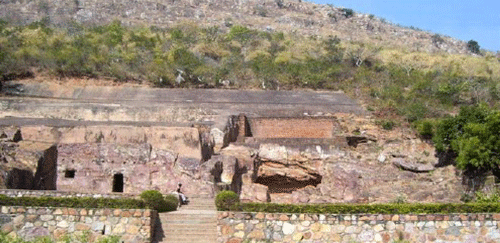
The name Rajgir might have come from Raja-griha ‘house of the king’ or ‘royal house’, or the word Rajgir might have its origin in its plain literal meaning, “royal mountain”. Rajgir is a city and a notified area in Nalanda district in the Indian state of Bihar.
Rajgir was the most famous city among the six great cities renowned during the time of Buddha. Since it lies in the middle of all other cities, it was called the Magadha or middle land. Moreover, it is one of the most important sacred places where Buddha dwelled. It was also the capital city of the king Bimbisara (Zugchen Nyingpo) and his son king Ajatasatru (Makye-Dra). There is controversy over the age of King Bimbisara, some say that he was of same age as the Buddha while others say that he was five years younger than the Buddha. However, there is no doubt that King Bimbisara was both patron and disciple of the Buddha. Due to this Buddha gave many teachings in and around Rajgir under the patronage of King Bimbisara. As the Buddha reconciled disagreement among the Sangha in Rajgir, it was later identified as the place of reconciliation. Since Lord Buddha expounded his teachings at many places within the boundary of Rajgir, it is difficult to write about them all, other than to give general information on the area.
According to the guide book of Thang-Sen-Tsang who visited the place some thousand years ago: The wooden platform at the side of the stone house which is about ten steps wide and about ten miles long is said to have been constructed by king Bimbisara for the purpose of seeing Buddha quickly whenever he wished to do so. The city of Kusha is located around 120 miles to the east of Rajgir. It is known as the City of Kusha because the glorious Kusha grass (the sacred grass used in religious ceremonies) grows there. Magadha was the prominent place where the ancient kings of central India always resided. It is in a valley surrounded by rocky hills like fencing. It is broader from east-west and narrower from north-south and the circumference of its surrounding area is approximately 300 miles. In this valley are found many foundations of ruined houses which were built within a circumference of 60miles. The pathways are adorned with trees with golden flowers. So during spring seasons the city looks like a golden city.
The stupa which stands outside the northern gate of golden city is said to be the spot where Buddha miraculously tamed the furious elephant (Nor-chong) sent out to harm him by Devadatta and king Ajatasatru. The legend goes: As Devadatta and the king Ajatasatru became intimate friends, two of them decided to instigate trouble for the Buddha and set the furious elephant towards him as he was walking casually along the way. But the Buddha stretched out his hand and from his five fingers emerged lions. At the sight of them the elephant collapsed and fainted instantly. And when the elephant regained its senses it was totally tamed.
Another stupa to the north-east of this one is the spot where Shariputra (Sharibu) attained liberation under the guidance of Ashvajit (Ta-thul). The story goes: During time when Shariputra was a lay person and became famous for being learned, Lord Buddha was residing in Rajgir with his five chief disciples. One day when Ashvajit was going for his alms, Shariputra saw him from a distance and called him, enquiring thus; “Oh! Respected monk, are your body and mind at peace? And what type of dharma makes you exalted physically and mentally?” Ashvajit replied; “What! Don’t you know Siddhartha? The son of the King Suddhodana, who renounced the sovereignty of the universal monarch and with immense compassion for sentient beings attained perfect enlightenment after striving with hardship for six years, is my great teacher. The Dharma he expounded was: neither existence nor nonexistence, wordless, inconceivable and it is the sole object of experience for only Buddha and persons of his calibre.” As soon as Shariputra heard this he understood the profound meaning and attained the level of Arhat.
In the vicinity of the above spot stands another Stupa, beside a deep trench. It is the place where Buddha tamed the non-Buddhist householder Palbay (Chimdag Palbay) and the trench is said to be doorway of the ruin of Palbay’s house.
The legend goes thus: During the time of Buddha there lived a house holder named Palbay who had faith in non-Buddhists. So a non-Buddhist who lived there at that time instigated Palbay to assault Buddha. He thought that Buddha was deceiving the masses, which affected their fame and honour. Thus he decided to assault the Buddha by any means. With this malicious intention he summoned Palbay and said: ‘‘dig a pit near your doorway and fill it with hot coals. Then mix food with poison and invite Gautama and offer him the dishes. If he does not die by falling into the fire pit he will definitely die by consuming poison.” Subsequently, Palbay obeyed his command and invited Buddha and his entourage for a meal as directed.
Many people knew about the conspiracy and stopped Buddha on the way but the Buddha didn’t agree to halt. Some people gathered to witness the scene. When the Buddha and his entourage arrived at Palbay’s residence as soon as the Buddha walked on the threshold of the door, the fire pit miraculously turned into a pond filled with the water of eight qualities covered with scented lotus flowers. Subsequently, Buddha and his entourage went inside the house and gently enjoyed the meals and expounded the teachings in accordance with the time and the situation. Thus, Palbay entered the authentic path, discarding the perverted views.
Another stupa located near the city to the north of this trench was the place where Tshojed Zhon-nu (a celebrated physician devoted to Buddha) offered Buddha a temple surrounded by the flower garden and fruit orchard. There you can also find the traces of Buddha’s footprints. These are all found in the guide book of Thang-Sen-Tsang.
In the centre of the town is a hot spring, where the ruins of the ancient enclosure can be seen even today. The hill where the hot spring is situated is one of the five great hills and it is called Ngoyang in Tibetan. To the north of the hot spring is hill called Kyasang in Tibetan. On top of the hill there is a stupa built by the Japanese.
Not far from the hot spring is a cave where, under the patronage of king Ajatashatru of Magadha, the great Shravakas Ananda, Upali and Mahakashyapa compiled the Sutra, Vinaya and Abhidharma respectively amidst the assembly of five hundred Arhats.
The print of the wheel seen on the way to Bodhgaya from Gridhakuta is said to be the print of the wheels of the chariot in which king Bimbisara and his retinue went to pay homage to the Buddha.
How to Reach Rajgir
- Air: The nearest airport is at Patna 101 km. Indian Airlines connects to Patna.
- Road: Rajgir is connected by road to Patna – 110 km, Nalanda – 12 km, Gaya – 78 km, Pawapuri – 38 km, Bihar Sharif – 25 km.
- Bus: Regular buses are available from all the above mentioned points to Rajgir.
- Local Transport: Taxis and Buses and Tongas are available to Calcutta, Bombay, Delhi, Ranchi and Lucknow.
- Rail: Though Rajgir itself has a railway station yet the nearest convenient railhead is at Gaya 78 km.
By Rigzod Editors