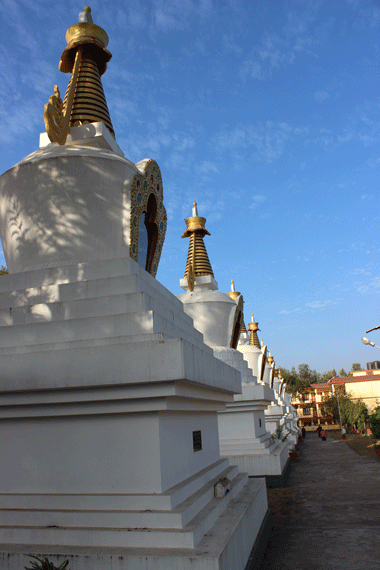
The practice of building stupas in sets of eight goes back to a tradition that was first started during and just after the time of the Buddha. When Buddha Shakyamuni displayed many extraordinary deeds in various places, devoted laypeople residing in those respective places built stupas to commemorate them. They have different structures to symbolise the significance of the deeds performed in those places.
Constructing stupas in these sets of eight became prominent after Lord Nagarjuna classified them as such. They are as follows:
1. Pepung Chorten (Stupa with Clusters of Lotus Petals)
This type was built by King Suddhodhana (the Buddha’s father) and noble laypeople of Kapilavastu to commemorate the birth of the Buddha. Generally, it has four circular steps adorned with carved images of lotus petals but it can have seven steps as well. It is popularly known as a Pepung Chorten but is sometimes known by other names like Desheg Chorten (Stupa of the Sugata) and Tashi Jungwai Chorten (Stupa Showering Auspiciousness).
2. Jangchub Chorten (Stupa of Enlightenment)
This type was built by King Bimbisara of Rajgir to commemorate the enlightenment of the Buddha. It has four simple square steps.
3. Tashi Gomang Chorten (Stupa with Many Auspicious Doors)
This type was built by the retinue of the five companions of the Buddha in Varanasi to commemorate his first sermon of the three turnings of the wheel of Dharma. It is also called a Yeshe Chorten (Stupa of Wisdom) or Chökhor Chorten (Stupa of the Wheel of Dharma) but it is popularly known as a Tashi Gomang Chorten. It has four square steps with carved images of 108 doors on large stupas, 56 in medium ones, and 16 in small ones.
4. Chotrul Chorten (Stupa of the Miracle)
In the grove called Zeta in Shravasti, the Licchavis and other devotees built this stupa to commemorate the Buddha’s act of defeating the six leaders of the tirthikas by displaying miracles. It has four square steps with four smaller projecting steps in the middle of each.
5. Lhabab Chorten (Stupa of the Descent of Lord Buddha from the Trayastrimsa Heaven)
The Buddha went to teach Dharma in the Trayastrimsa heaven to repay the kindness of his mother who had been reborn there. Then he descended back from there to earth. To commemorate this deed, the people of village called Selden in Vaishali built this type of stupa. It is also called a Sumchu Tsa Sum Lhayi Chorten (Stupa of the Trayastrimsa Heaven) but is more widely known as a Lhabab Chorten. It has four square steps with smaller projecting steps in the middle. There is also a carved image of a staircase in middle of the smaller steps.
6. Yendum Chorten (Stupa of Reconciliation)
When the cousin of the Buddha, Devadatta, created a schism in the assembly of monks, Shariputra and Maudgalyayana, at the request of the Buddha, reconciled the monks. To commemorate this deed, the devoted people of Magadha built this type of stupa. It is also called a Ödzer Chorten (Radiant Stupa) or Jam-ngoe Chorten (Stupa of Real Love) but is widely known as a Yendum Chorten. It has four octagonal steps which look like the shape formed by evenly cutting the corners of square steps.
7. Namgyal Chorten (Stupa of Complete Victory)
When the time was near for the Buddha to pass away, Tsunta, a son of a Licchavi, requested him to stay longer, so he extended his life for three more months. In order to commemorate this act, the people of Vaishali built this type of stupa. It is also called a Jinlab Chorten (Stupa of Blessings) but is more widely known as a Namgyal Chorten. It has four circular steps.
8. Nyangde Chorten (Stupa of Parinirvana)
This type of stupa was built to commemorate the mahaparinirvana of the Buddha in Kushinagar. It does not have any steps or a recessed image.
By Rigzod Editors