The mandala, which literally means ‘circle’ in Sanskrit, has many purposes in different spiritual traditions. According to the tradition of Tibetan Buddhism, there are two aspects where the name mandala is applied, based upon its literal presentation and its symbolic significance. These two aspects are the representation of a palace of a meditational deity and that which represents a mode of offering. It is the latter that will be introduced here.
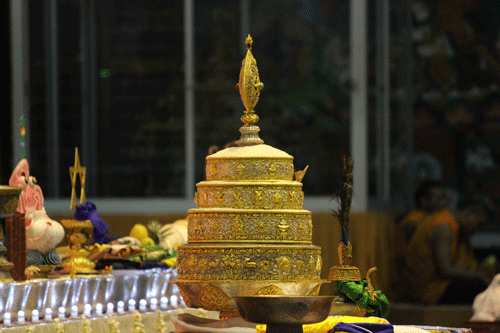
The significance of the mandala as a mode of offering is discussed in both the earlier and later secret tantric teachings as an extraordinary step along the spiritual path and a positive way to accumulate the provision of merit. To bring this into actual practice, there is the general tradition of using a symbolic mandala kit, which consists of three rings of decreasing circumference stacked upon a base. There are three types based on their qualities: the superior one is made of gold and silver, the middling one is made of iron, and the inferior one is made of stone or wood. Its height should not be less than a foot, after it is established. The shape can be circular or any other shape. It is said that it is good for rich people who are greedy to have the inferior type, even though they can afford the superior type. The reason for this is that during the offering they might get attached to the mandala and this would cause the person to become bound by attachment rather than accumulating merit.
The rings represent the different realms of beings, and are adorned, in some cases, with carved images of leaves, the eight auspicious symbols, the seven royal treasures, the five sense pleasures, the offering goddesses, the seven types of gems and the deer and wheel dharma emblem on the top. Simple rings with or without any kind of images or colours can also be used. However, these images represent the precious substances that we should visualize during the offering.
The mandala is created by heaping up within the rings ornamental offering substances like turquoise, coral, pearl and the five kinds of grains, all suffused with fragrance. Some texts mention that one can even use clean sand or stones. The sequences of heaping up the offerings are of nine types: forty-one, twenty-three and seven heaps are the extensive, medium and condensed methods respectively for nirmanakaya mandalas; twenty-four, thirteen and seven heaps for sambhogakaya mandalas; and twenty-five, five and three heaps for dharmakaya mandalas. These are all mentioned by the omniscient Longchen Rabjam. Even so, general mandala offerings are also made with nine or thirty-seven heaps. During the offering, one should visualize the objects of offerings being as extensive as one’s imagination can reach. The more extensive the offering is, the more the accumulation of merit we will acquire.
According to the type of visualization, the mandala has three aspects: physical, spiritual and secret. Physically, the centre of the mandala is Mount Sumeru, visualized as a mountain of gems, surrounded by four continents,1 each with their two sub-continents2 at each of the four sides of the mountain, and further bordered by a ring of golden mountains. There are also the precious and desirable endowments such as the wish-fulfilling tree, the wish-granting cow, a bountiful harvest, the seven royal treasures, the great treasure vase, the eight offering goddesses, the sun and moon, a precious parasol, a victory banner, and so forth, both offered as one’s real possessions and also visualized in one’s imagination, including all phenomena that are owned and unowned. Visualizing all these physical provisions, we should offer them to the buddhas and bodhisattvas.
Spiritually, the mandala is offered by visualizing it as the following: one’s own skin as the golden base, the intestines as the surrounding iron mountains, the backbone as Mount Sumeru, the head as the palace of victory, the four limbs as the four continents, the eyes as sun and moon, the ears as Rahula3 and duemey4, the nose as the treasure vase, the tongue as the wish-granting cow, the ten toes as the ten outer offering goddesses, the ten fingers as the ten inner offering goddesses, the eight major joints as the eight auspicious substances, the organs as the seven royal treasures and the hairs as all the possessions of gods and humans. These are not just offered by mere imagination but present in one’s body from the time immemorial as a conceptual essence.
The mandala of the secret aspect is offered by visualizing the all-ground consciousness that is realized as the ultimate aspect of the body and wisdom through arousing the habitual tendency of the thirty-seven aspects of enlightenment, as well as the ground, path and fruition aspects of the Mahayana.
Further, the nirmanakaya mandala is the pure land of Brahma where Vairochana, one of heads of the Five Buddha Families, dwells in Gangchentso (Immense Ocean of Mountains) along with his ongoing cycle of the inexhaustible adornments of body, speech and mind. The sambhogakaya mandala is the Gandavyuha Akanistha, the densely arrayed buddhafield, along with miraculous manifestations of the five wisdoms. The dharmakaya mandala is the heap that coalesces into one the multiple conceptual thought patterns of arising, dwelling and ceasing. Similarly, the mandala of absolute suchness is the essence that is aroused as the miraculous manifestations of the clearly luminous Great Perfection, primordially liberated, non-abiding, and free from the limitations of conceptual elaboration from the very beginning.
Thus, having such symbolic significance in accumulating merit, Buddhists maintain the tradition of offering the mandala in monasteries, especially on special occasions, as well as in homes. Further, the mandala is offered specifically during the Dzogchen preliminary practices by heaping them up again and again, eventually accumulating one hundred thousand repetitions.
By Pema Tenzin
8th Year, NNI
- The four continents surrounding Mount Meru are Purvavideha, Jambudvipa, Aparagodaniya, and Uttarakuru, in the east, south, west and north respectively.
- The eight sub-continents surrounding Mount Meru are Deha and Videha, Chamara and Aparachamara, Satha and Uttaramantrina, and Kaurava and Kurava in the east, south, west, and north respectively.
- A demon who tried to capture the sun and moon but was subdued and is now said to be one of the planets.
- The fire at the end of an eon.