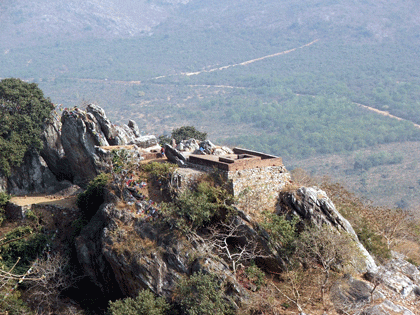
Vulture Peak (Skt. Gridhakuta) is one of the most important places associated with the life and teachings of Lord Buddha, besides Bodhgaya and Deer Park. Vulture Peak is a small mountain just outside the ancient city of Rajgir, India. Sixteen years after his Enlightenment, the Buddha turned the Second Wheel of Dharma at this site for an assembly of 5,000 monks, nuns and laypeople, as well as innumerable Bodhisattvas. This collection of teachings was unveiled over twelve years, and includes the Sadhdharma-Pundarika Sutra, the Suramgamasamadhi Sutra and many other Prajnaparamita sutras, which contain the very essence of all his teachings.
The actual name of Vulture Peak is Gridhakuta. There are many versions of the theories about the naming of this hill. Some say that it was named Vulture Peak because the shape of the hill looks like a gathering of vultures. On the other hand, many say that it was once a charnel ground, where many vultures used to soar and live. However, according to an ancient guidebook written by a noble monk from China, Xuanzang, it is mentioned that approximately eighty miles to the northeast of the city of Magadha, there is a place called Kanarika―the place where Vulture Peak is situated. The appearance of the hill is perceived differently from different directions and distances but if it is seen from afar, it appears like a large assembly of vultures. Thus, this could determine the reason behind the naming of this hill.
During the time of Lord Buddha, one of his lay disciples, King Bimbisara, ordered his countrymen to build a causeway leading up to the hill. They built it with solid stones for the Buddha and his noble disciples. There is a mango grove called Amaravana at the foot of the hill which was offered to the Buddha by the physician Jivaka. The remains of old monasteries are also still seen there. The structure of the hill is broad at the east and west sides and narrow towards the north and south.
There are many interesting things to see at Vulture Peak, including a life-size statue of the Buddha. To the east of the statue, there is a huge, flat piece of rock like a platform, where the Buddha taught the White Lotus Sutra to his disciples. To the south, there are eaves under which the Buddha used to meditate. Just behind this dwelling, there is one more stone house where Ananda meditated for long time.
History says that once when Ananda was in deep meditation at Gridhakuta, Mara, the demonic lord of desire, manifested in the form of a vulture and tried to disturb him. At that moment, Ananda prayed to the Buddha with a single-pointed mind and in his vision he saw Lord Buddha raise his right hand and put it on top of his head. He experienced an instantaneous blessing of the Buddha in the form of bliss and peace. Even today, footprints of the evil vulture are visible on some of the rocks. There are also many small caves and meditation cells, where the sublime Shariputra and other Arhats meditated.
On the other side of the hill, there is a dried well and a large flat rock. It is said that this is the place where the Buddha’s robe was washed and dried on the rock by his disciples. Even to this day, the imprints of the needlework of the robe are visible on this enormous rock. Nearby, there is also a footprint of Buddha. Though it is not clear, the imprint of a dharma chakra is also apparent. At the peak, a magnificent stupa built by King Bimbisara was there. The place where the stupa stood is sacred ground where Lord Buddha turned the Second Wheel of Dharma for seven days.
May this information benefit beings like the moonlight on a dark night!
By Padma Mani Translation Group