Following the sutras and having relied on authentic sources, researchers have identified most of the sacred sites where the Buddha performed various extraordinary deeds. Yet, the sacred stupa of Vishuda—erected at the place where the Buddha renounced all his worldly belongings—held a controversy among the researchers about where the actual site is located. Some pilgrims believed that the site was inside a small town near Gaya, where we can see an old Hindu temple. On the other hand, there were some other pilgrims who pointed to a place called Loriya Nanten Ghar as an optional site, but in neither of these cases was there any evidence to prove this.
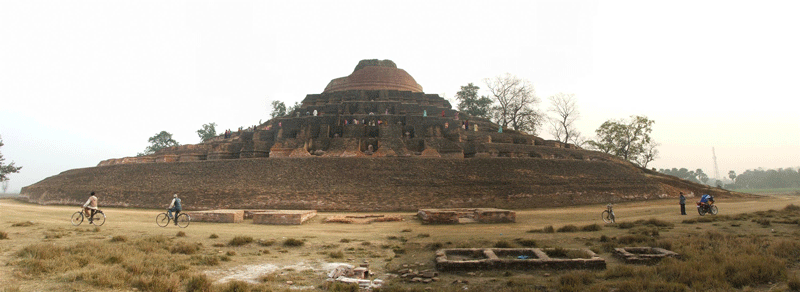
According to the actual research, the site of Chorten Namdak Drung, as the sacred stupa of Vishuda is known in Tibetan, shares a close description with Kesaria, a town in Bihar. This is the site of a stupa built by King Ashoka. In the local dialect, the word ‘kesaria’, means ‘the spot of cutting hair’. These brief details and some other evidence enabled the researchers to claim that Kesaria is the place where the Buddha became a renunciant. For instance, it is described in an old guidebook thus:
“Two miles from here (Kesaria) one comes across the holy site of Gashala, where the Buddha renounced everything. There is a stupa with several doors and its circumference is equal to six arm spans (nine meters according to linear measurement). Carved images of the Buddha are seen on each of three sides but not on that to the west. There is an opening from the westward side of the stupa and inside it the beautiful images of eight sacred sites are seen on the stone surface. In the centre, one can see a statue of Buddha Shakyamuni. The upper part of the stupa has twelve different layers, on top of which a crown is set. The main stupa is surrounded by more than thirty small stupas.”
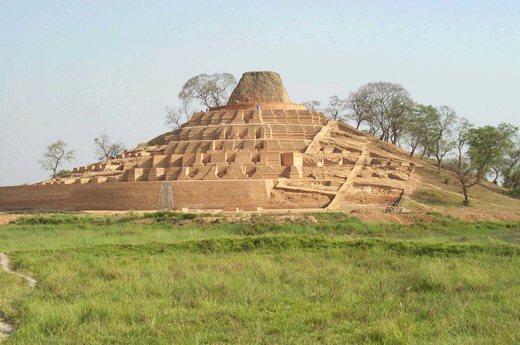
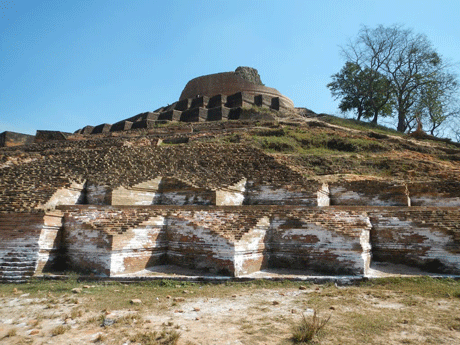
According to the guidebook of the Chinese Tang dynasty pilgrim Xuantsang, there is further explanation: “Following the trail across the thick forest towards the east, there is a stupa built by King Ashoka where the Buddha displayed his extraordinary deed of renunciation.”
Lord Buddha left his palace in search of truth. He began his spiritual journey by mounting a chariot led by his horse Kanthaka. When they reached a place far away from Kapilavastu, the Buddha stopped the chariot and there he cut his hair himself and dressed in saffron robes. Thus, the Buddha became a self-ordained monk who has renounced all worldly comforts. A small stupa can be seen in this particular spot where the Buddha became a self-ordained monk by exchanging his princely attire with the clothing of a hunter. The story of the Buddha and the hunter is said to have happened at this particular place where the aforementioned stupa is built.
When the Buddha became a renunciant, he sent his jewelled crown back to his father but he was still left with few other ornaments and fine clothes. The Buddha thought that it was not appropriate for a renunciant to own these fineries. As soon as this thought came, a god from Akanistha heaven manifested as a hunter and appeared in front of the Buddha. Holding the ornaments and remaining clothes, the Buddha approached the hunter and said, “Would you agree to exchange your things with mine?” The hunter replied with immense joy, “Yes, I agree!” The hunter took all those luxurious ornaments and departed back to Akanistha heaven.
The site of the stupa of Vishuda is considered to be one of the holiest sites for the Buddhist community. Today, we can see thousands of pilgrims from various parts of the world coming to this sacred site to pay homage. Visiting this site will help one to know and understand the life of the Buddha. Thus, it enhances one’s spiritual qualities and inspires one to follow the path of Enlightenment.
By Kunzang T. Choki
5th Year, NNI