Cham: Ritual Dance

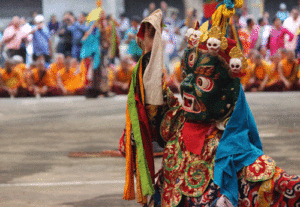
Generally, cham (ritual dance) falls under the drama category of the ten distinctive arts of Tibetan Buddhism. In a broader sense, it is an art of dancing according to the sound of cymbals, drums, trumpets or other instruments. However, ritual dances are related to gar-thig-yang sum (dance, drawing mandalas, and ritual melodies). It is defined as a spiritual art of…
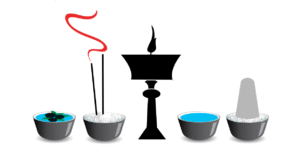
Five Offerings

What are known as the “five offerings” in Tibetan is choepa-na-nga. They comprise one of the “seven practices” and provide a method for accumulating merit and reducing attachment towards worldly pleasure. Though making offerings can be classified into many subdivisions, here it is classified into five: the offering of flowers, incense, butter lamps, scented water, and ritual cakes (direct translation…

Activities at Namdroling Monastery, 2018

Dratsang  On December 22, 2017, His Holiness the Dalai Lama consecrated the recently renovated main temple, Orgyen Dongag Shedrup Yoesel Dargyeling (widely known as the Golden Temple). On February 3, 2018, as usual, all the monks gathered together to commemorate the Mahaparinirvana of great charioteer of the Ngagyur Nyingma teachings, the omniscient Longchen Rabjam, and performed rituals for his death…

Uttaratantra Shastra

The Uttaratantra Shastra is one of the Five Treatises of Lord Maitreya (jamchö dé nga). It is a treatise explaining the vast meaning of the teachings taught by the Buddha when he turned the third wheel of the Dharma. This treatise mainly expounds on buddha nature—the unchanging pure innate nature of all sentient beings present from beginningless time. It can…

Jarung Khashor Stupa

The Jarung Khashor stupa is a famous Buddhist stupa located about 11 km from the centre of Kathmandu in its north-eastern outskirts. It is a sacred stupa related to the profound deeds of Lord Avalokiteshvara and Khen-Lop-Choe Sum of Tibet. The narrative goes like this: Many eons ago, Lord Avalokiteshvara promised in front of Buddha Amitabha to liberate all the sentient beings…

Interview with His Holiness Karma Kuchen Rinpoche

Palyul Times: Your Holiness, would you please tell us about the conditions necessary for practising the Dharma through your experience? H.H. Karma Kuchen Rinpoche (KKR): In order to practise the Dharma, the first condition necessary is that one should have the compassionate mind of bodhichitta. This is because if we don’t have compassion, there is no other ways to practise…

Interview with Khenpo Tashi Tsering

Palyul Times (PT): Tashi delek! Venerable Khenpo, firstly, would you please give us a brief introduction about yourself?  Khenpo Tashi Tsering (KTT): To say something about myself, my birthplace is in one of the four sacred places concealed by the “Lotus-Born” (Guru Padmasambhava) that is situated near a place called Kimlung, North Nepal. I was born there in 1958. I…

Intoxicating Lady

Once the Bodhisattva was born as a king in a village called Shevi. He ruled his country with love, protecting people from harm, both from inside and outside, and treated them with justice. He let his people follow good religion and never humiliated other religions. In that village, there was a beautiful lady, who had a glorious body and a…

The Girl Who Brought the King Back from the Dead

The Girl Who Brought the King Back from the Dead The Story of a Zombie is a fascinating tale said to have been written by Nagarjuna. In the previous issue of Palyul Times was the prologue where a young beggar was given the name Decho Sangpo and was prince by a spiritual master, who saw in him certain good qualities. The master…

Six Transcendent Perfections

Transcendent perfection in Sanskrit is paramita.  Para means “beyond” and mita, “to go”. Together it means to go beyond worldly merit, and that of the shravakas and patyekabuddhas. The transcendent perfections are generally defined as a means of attaining enlightenment and are endowed with four distinctive attributes. The four distinctive attributes are as follows: 1. They are free from their…